

Buying a home in LA when you’re moving from the UK
Short answer: buying in LA moves really quickly compared with England. Once buyer and seller agree on a price and terms, you have a binding contract. There's usually no chain either, because in LA, offers that depend on the buyer selling another home are much less common. Most purchases close in about 30 to 45 days. The costs are different too. There's no stamp duty, but there is something you don't have in the UK: a yearly property tax, usually around 1.25% of the purchase price. And inside the City of LA, a transfer tax jumps on homes above $5.4 million.
I moved to LA at the end of 2012, so I've been where you are: not knowing where to start, and not knowing much about the neighborhoods beyond the places I'd stayed on vacation, like Santa Monica or West Hollywood. And moving here with a family is a completely different exercise from moving as a single person or a couple without children.
This page is a short introduction to how buying works here compared with the UK, the costs Brits don't anticipate, getting a mortgage without US credit history, schools, and why a lot of UK clients rent for a few months to a year first. Wherever I've written about something in more depth, you'll find a link.
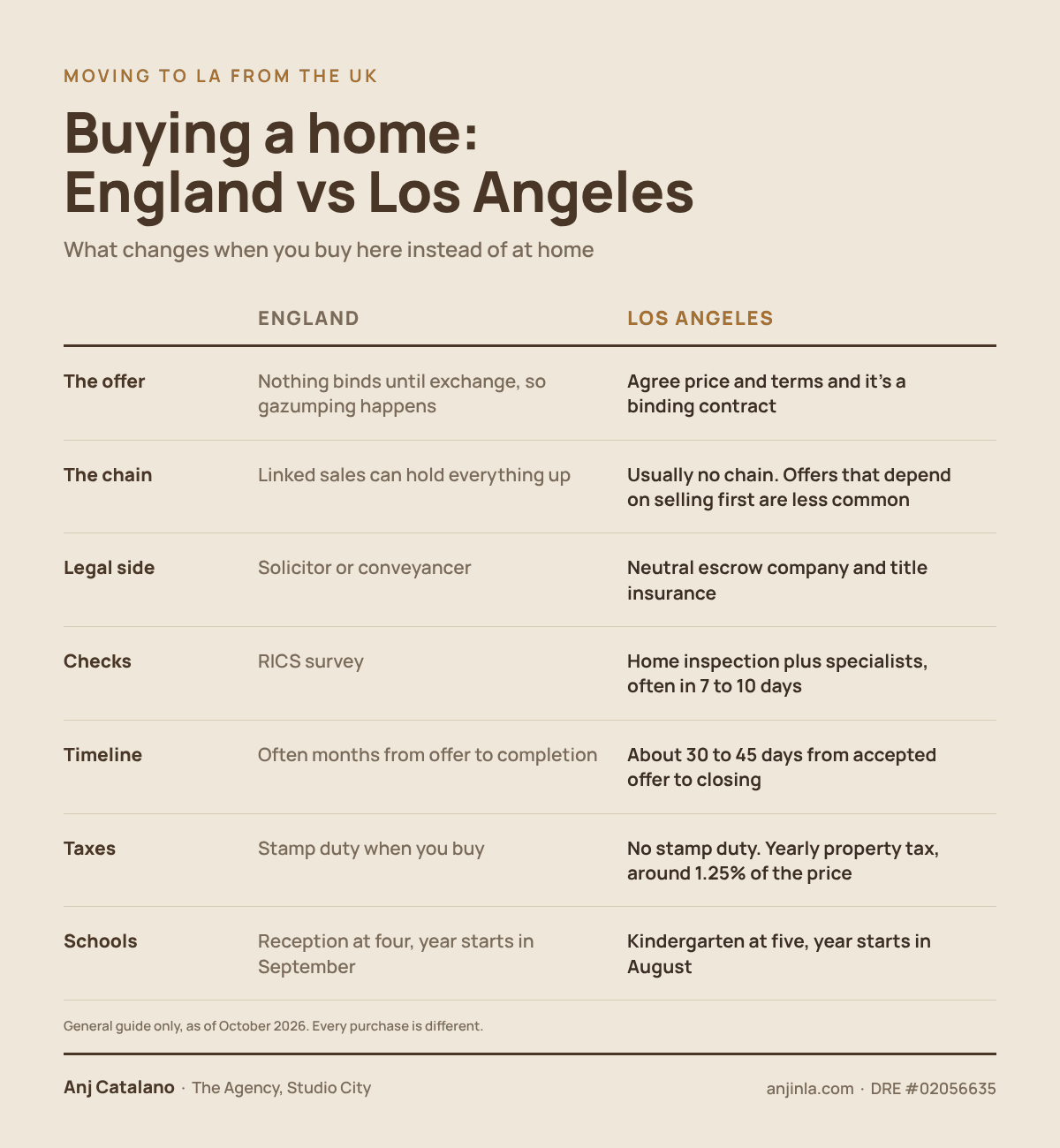
How buying here is different from England
The biggest shift is that an accepted offer here is a real contract, not a gentleman's agreement until exchange. That changes how fast everything can move.
The offer. In England nothing binds until exchange, so gazumping happens. Here, once buyer and seller both sign, it's a binding contract. The seller can take backup offers but can't simply swap you out.
The chain. Most purchases here aren't tied to a chain. Some buyers make offers contingent on selling, but sellers here tend to resist them.
The legal side. Instead of a solicitor or conveyancer, a neutral escrow company holds the money and documents, and a title company insures the title. Many buyers never use a lawyer.
The survey. Instead of a RICS survey, you get a general home inspection, then specialists as needed: sewer line, roof, foundation, termites.
The timeline. Often 30 to 45 days from accepted offer to closing, rather than months.
Your agent. Your buyer's agent's pay is agreed with you in writing, and you can ask the seller to cover it as part of your offer.
A few things worth knowing before you start:
The inspection window is short. California's standard contract gives you 17 days to inspect, read the seller's disclosures and decide. In reality, to be competitive, buyers often shorten that to a week or 10 days, or about two weeks for a more complicated property, like a hillside home or one with a pool.
Sellers have to disclose. In California, sellers are required to disclose what they know, or should know, about the property. Read the disclosures properly, they tell you a lot.
You'll sign an agreement with your agent first. California law changed a couple of years ago. You now need a written buyer representation agreement, signed no later than when you make an offer. It can last no more than three months and has to spell out how your agent is paid. More on the process in what happens during escrow in Los Angeles.
The costs Brits don't see coming
There's no stamp duty here, which feels like a win until you meet property tax. You pay it every year, for as long as you own the home.
Property tax. In practice it usually comes to around 1.25% of your purchase price a year. That's California's 1% base rate plus voter-approved bonds and local assessments, which vary street by street, so always check the actual tax bill for the address. Once you own the home, its assessed value can rise by no more than 2% a year.
The supplemental tax bill. When you buy, your first regular tax bills are still based on what the previous owner paid for the home. Within your first year, the county sends a supplemental bill to make up the gap between their purchase price and yours. If the previous owner had the home for a long time, that gap can be big, so budget for it. It can occasionally work the other way: in the one case I've seen where a home sold for less than the previous owner paid, my clients were very happy to get a $500 check back from the county.
The City of LA transfer tax, often called the mansion tax. Inside the City of Los Angeles, sales from $5.4 million to just under $10.9 million carry an extra 4% tax, and sales of $10.9 million or more carry 5.5%, on top of the city's base 0.45%. Those thresholds took effect July 1, 2026 and move each year. It only applies within City of LA limits, so places like Burbank and Calabasas aren't covered by it. By custom the seller pays transfer taxes in LA, but who pays can be negotiated, so it matters to you as a buyer too.
Insurance. Standard homeowners policies here don't cover earthquakes, that's a separate policy. In some hillside and canyon areas, fire cover has become harder and more expensive to get, so get insurance quotes during your inspection window, not after.
HOA dues. Most condos and some gated communities charge a monthly homeowners association fee. Ask for the HOA's budget and meeting minutes, they show whether a big repair bill is coming.
Getting a mortgage without a US credit history
Your UK credit score doesn't come with you. US lenders work off US credit history, so a new arrival with an excellent record at home can look like a blank page here.
Expect a bigger deposit. Buyers who aren't US residents typically need 30% to 50% down through specialist foreign national lenders. Green Card holders can access the same loans as US citizens.
Start building credit the day you land. Open a US bank account and get a card early, even before you start looking. An ordinary prepaid card won't help, because it doesn't report to the credit bureaus. But there's a newer kind of credit builder card that works much like one: you load your own money, spend it, and your payments are reported to the bureaus. Some are made for newcomers and accept a passport with a visa or ITIN instead of a Social Security number, Firstcard is one example. A secured card such as Discover it Secured does the same job with a refundable deposit, and American Express lets newcomers apply using their UK credit history through a service called Nova Credit. These products change often, so check the current terms before you apply.
Paperwork takes longer. Lenders usually want two years of income proof, bank statements and evidence of where your deposit money came from. Have it ready before you make an offer, because the clock starts fast here.
Watch the exchange rate. If you're paid in pounds and borrowing in dollars, currency moves change what you really pay each month. Bank transfer markups add up on a deposit this size, so compare before you send.
Tax on both sides of the Atlantic is its own subject, so talk to a cross-border tax adviser before you buy, not after. I go further into this in buying Los Angeles real estate from abroad.
Schools: the timing catches UK families out
If you have children, schools will decide your timeline more than the housing market will.
Children start school a year later here. In England most children start Reception at four. Here, kindergarten starts at five and first grade at six. It really surprised me at first, but in hindsight I've come to like it, and I think it's been good for my son.
The school year starts in August, not September. LAUSD's first day for 2026 to 2027 is August 12, 2026. If you're planning a summer move, aim to arrive by early August.
Private school applications close a year ahead. For fall 2027 entry, deadlines at LA private schools run from late September 2026 to early March 2027, mostly November through January. If you're moving next summer, you're applying now, often before you've chosen a house.
Year groups shift by one. California's kindergarten cutoff is turning five by September 1, close to England's year cutoff. So a child going into Year 3 in England usually goes into 2nd grade here. Kindergarten is optional in California, and a transitional kindergarten year covers many four-year-olds.
Your address picks your public school. Studio City, Sherman Oaks and Encino are all in LAUSD, and the assigned school depends on the exact address, not the neighborhood's reputation. Check the boundary before you make an offer.
For more, see moving to LA with kids, top private schools in the San Fernando Valley and public vs private schools in the Valley.
Why a lot of my UK clients rent first
Renting for a few months to a year is often the smartest first move, not a delay. LA is huge, and the difference between two neighborhoods twenty minutes apart can be the whole feel of your life here. You don't know that from London.
You learn the traffic and the neighborhoods. A commute that looks short on a map can be miserable at 8am. A few months here shows you which neighborhoods you like and which vibe actually suits you.
Your credit history builds while you rent. By the time you buy, lenders have something to look at.
Schools get sorted first. Once you know where your children are going, the house search gets much narrower.
You can rent well. I also handle high-end leases, and for many of my relocating clients that's where we start before they buy.
The numbers behind this are in renting vs buying in Los Angeles.
Where Brits tend to land
I've written a whole guide on this, the best LA neighborhoods for Brits making the move. The short version:
Santa Monica for walkability, the beach and an established British community, at a price.
Sherman Oaks for families who want space and a proper high street along Ventura Boulevard.
Studio City for a more polished Valley feel.
Toluca Lake for a small, village-like pocket close to the Burbank studios.
West Hollywood for walkable city living, which is where I spent my first ten years here.
Los Feliz and Silver Lake for older Craftsman and Spanish homes with a creative feel.
For the Valley in detail, see my guides to Sherman Oaks and what people wish they knew before moving to the Valley.
Questions UK buyers ask me
Can I buy a home in Los Angeles if I'm not a US citizen?
Yes. There's no citizenship or residency requirement for a UK buyer to own a home here. The harder part is financing, because US lenders want US credit history, so non-residents usually put down 30% to 50%.
How long does it take to buy a house in LA?
Usually 30 to 45 days from an accepted offer to closing. You get 17 days under California's standard contract to inspect the home and review the seller's disclosures.
Is there stamp duty in California?
No. Instead you pay property tax every year, usually around 1.25% of your purchase price once local assessments are added to the 1% base rate. Inside the City of LA there's also a transfer tax on sales of $5.4 million and up.
Can I be gazumped in LA?
Not in the English sense. Once you and the seller both sign the purchase agreement, it's a binding contract. The seller can accept backup offers, but they can't just walk away for a higher one.
Should I rent before I buy in LA?
For many people moving from the UK, yes, for a few months to a year. It gives you time to learn the neighborhoods, sort out schools and build the US credit history that makes a mortgage easier.
When should I apply to LA private schools?
About a year before you arrive. For fall 2027 entry, most deadlines fall between November 2026 and January 2027.
Why do LA children start school later than in England?
In England most children start Reception at four. In California, kindergarten starts at five and first grade at six, so a child usually lands one year group lower than they would in England.
Do I need a solicitor to buy a house in California?
Usually not. A neutral escrow company manages the money and paperwork, and a title company insures the title. Some buyers still hire a lawyer for complicated purchases.
Final thoughts
If you're planning the move and want to talk it through, I'm happy to help. I've done it myself, and I work with a lot of people coming from the UK. Reach out at hello@anjinla.com.
Anj Catalano | The Agency | Studio City / anjinla.com | DRE #02056635
Search the guides